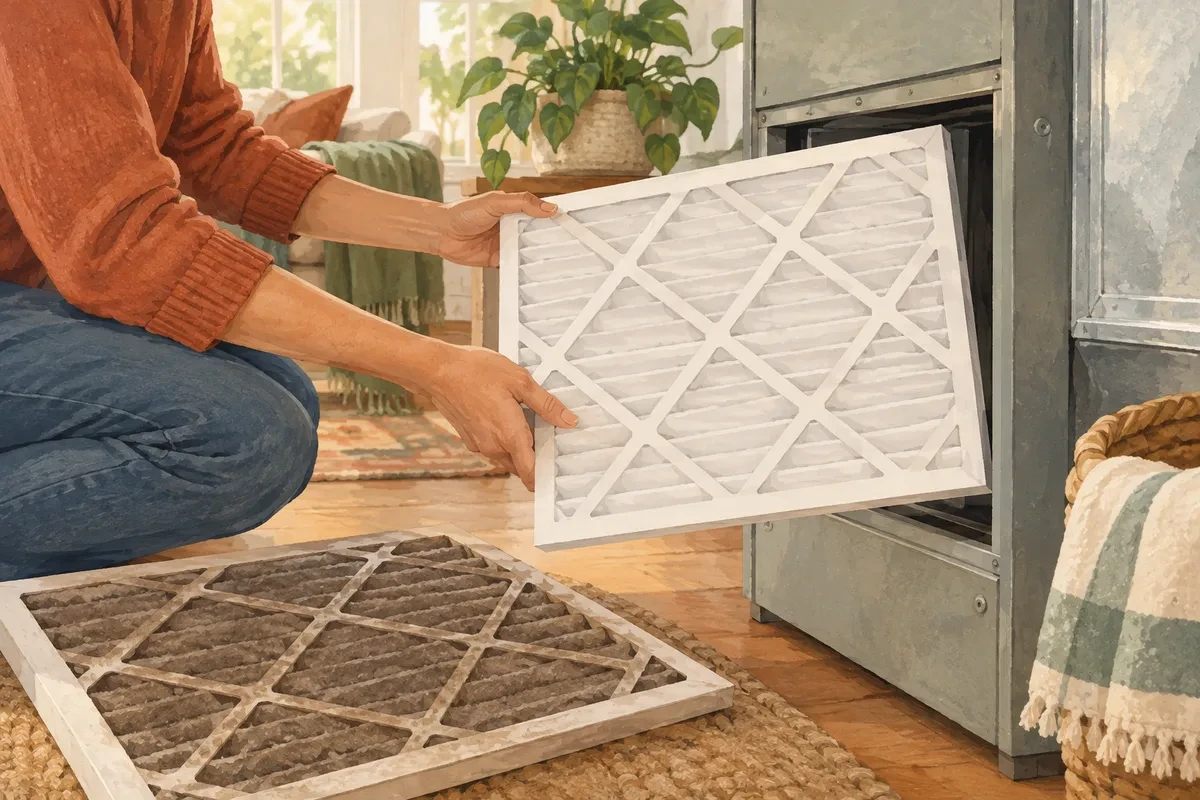
The Humble Air Filter: When and Why to Change It
It is easy to forget about the air filter tucked away in your heating and cooling system. It does not make noise, it does not have a light that blinks when something is wrong, and most of the time it just sits there quietly doing its job. But that small piece of folded material has a big impact on how well your system runs and how comfortable your home feels.
Whether you have a furnace, a heat pump, or central air conditioning, the filter is one of the easiest parts of your system to check and change yourself. Yet it is also one of the most commonly overlooked pieces of home maintenance. Let's talk about what filters actually do, how often they need attention, and how to choose one that fits your home.
What the Filter Actually Does
Your HVAC system pulls air in, heats or cools it, and pushes it back out through your ducts. The filter sits in that airflow path and catches dust, pet hair, lint, and other particles before they can travel through your ductwork or settle inside the equipment itself.
This matters for two reasons. First, it helps keep the air moving through your home a little cleaner. Second, and just as important, it protects your system. When particles build up on the coils or blower components inside your unit, the system has to work harder to move air. Over time, that extra strain can wear down parts faster and drive up energy use.
So the filter is really doing double duty. It is a small barrier between your living space and the buildup that would otherwise collect inside your equipment.
How Often Should You Change It
There is no single answer that fits every home, because it depends on the type of filter, whether you have pets, how many people live in the house, and even the time of year. That said, a general rule of thumb is to check a basic filter every month and plan to replace it every one to three months.
Homes with shedding pets, someone who smokes indoors, or ongoing construction or renovation work nearby usually need more frequent changes. Homes that run their heating and cooling system heavily, like during a Raleigh summer when the air conditioner barely shuts off, also tend to load up filters faster.
A simple habit is to pick a day each month to glance at the filter. Hold it up to a light. If you cannot see light coming through clearly, it is time for a new one. This quick visual check takes less than a minute and can save you from running a clogged filter for weeks without realizing it.
Picking the Right Filter for Your Home
Filters are usually rated by a number called MERV, which tells you how fine a particle the filter can catch. Higher numbers catch smaller particles, but they can also restrict airflow more if your system was not designed for them. This is why it is worth checking your system's manual or asking a professional before jumping to the highest-rated filter on the shelf, especially in older systems.
For most households, a mid-range filter offers a good balance between catching everyday dust and pet hair without putting too much strain on the blower motor. If someone in your home has allergies or breathing sensitivities, a slightly higher-rated filter may be worth considering, but it should still match what your specific equipment can handle.
Reusable filters exist too, and they can cut down on waste, but they need regular cleaning to stay effective. Whichever type you choose, the size matters as much as the rating. A filter that does not fit snugly in its slot will let unfiltered air sneak around the edges, which defeats the purpose entirely.
Signs Your Filter Is Overdue
A few clues can tell you a filter has been neglected for too long. Rooms that used to feel evenly heated or cooled start to feel uneven. Your system runs longer than it used to, trying to push air through a clogged path. You might notice more dust settling on furniture even though you are cleaning regularly, since the buildup inside the filter can eventually pass small amounts of debris back into your air stream once it is packed full.
If you ever pull out a filter and it looks gray, matted, or thick with fuzz, that is well past due. A fresh filter should look close to white or its original color, with clear folds you can still see through.
When to Call in Help
Changing a filter is one of the simplest tasks a homeowner can handle, but figuring out the right type, size, and schedule for your specific setup is not always obvious. Ductwork condition, system age, and household habits all play a role, and what works for a neighbor's home might not be the best fit for yours.
If you are unsure what filter your system needs, how often to change it, or whether ongoing airflow issues point to something bigger happening inside your ducts or equipment, our team at Blue Heron Heating & Air is happy to talk it through with you. We serve homes throughout Raleigh, NC, and a quick conversation can often clear up questions that have been nagging at you for months.
Give us a call whenever you want a second opinion on your filter setup or notice something off with how your system is running. It is a small part of your home, but keeping it in good shape goes a long way toward a comfortable house all year round.
Questions about your own situation? The team at Blue Heron Heating & Air is happy to help — call us at (919) 555-0164 or request an appointment.
This article is for general information only.